Foreword, Ten Years and Five Months Later
It is late December 2022. Amid the COVID-19 pandemic, I sorted through a mystery novel I wrote ten years ago.
Sad Slow Song was published in my personal QQ Space on July 16, 2012, and classmates read it. After many revisions, it was finished on August 17. I mentioned it in “I Came Back, but I Will Soon Set Out Again” . Moving it here revealed that its thirty-thousand-plus words are indeed【redundant】. Two other Posen Wall stories (The Change and Six-Fold Answer: The Necklace 2) will follow.
I packed this orthodox mystery with my views of the world. They may seem immature now, but they were the beginnings of my thinking.
I am glad my younger self could write this, and hope that ten years later it can become an encouraging force that helps us move through the world with hope.
Here is the original text. I hope you find something in it.
Foreword
This is Posen Wall’s first case after taking over. He is inexperienced, and Charlie Insect has not yet joined him, so his thoughts can briefly be seen. As the investigation deepens, those thoughts become fewer; the reason is obvious… (The image can be downloaded from the album.)
More than thirty thousand words, barely polished. The clues are mostly given before the solution; judge the trick for yourselves.
! Map
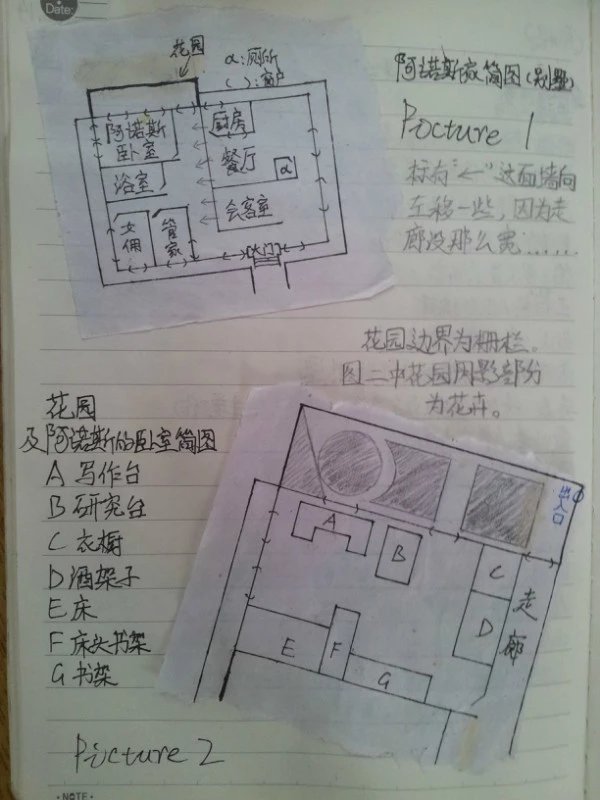
Important Characters
George Anos — mathematics teacher at Moyan High School; writer
Posen Wall — company employee
Chen Pingguo — Anos’s butler
Li Xue — Anos’s maid
John Clisen — real-estate developer
Jane Rollman — painter
Wang Xinchang — newspaper editor
Margo Binsongji — model
Hippomenes Mosifa — newspaper deliveryman
Boris Tay — private detective
Huang Yeling — Chinese-language teacher at Moyan High School
Massol Riley — inspector
Alan Lerrich — English teacher at Moyan High School
Lu Ranzhi — detective
Lu Hang — detective
Zhang Yan — forensic doctor
Prologue: The First Lament
A teacher should not merely teach books; his duty is to teach people how to live. A student should not merely read books; his duty is to learn the way of life. — Tao Xingzhi
2000, date unknown Moyan High School Library
On summer nights at Moyan High, toads called without end. Huang Yeling had taught there for years and was used to it. She taught senior-year Chinese and also ran the library, where she sat reading The Count of Monte Cristo.
Few students came at night. There were more than ten copies of most books, and the entrance was beside the desk, so she gradually lost herself in the story.
Before she finished Chapter Two, a student entered. Without greeting her, the student went to the shelves. She felt annoyed, then decided the student probably thought she was studying and did not want to interrupt.
The student soon brought several books. “Teacher, I want to borrow these.” The low stack looked odd. Worse, the student wore gloves.
“All right.” She stood. The top book fell with a slap, and the toads abruptly fell silent.
“Sorry, I will pick it up.” The student vaulted the counter just as she bent down.
“Here is your book.” She straightened and raised it to the student.
The student stuffed a towel into her mouth and twisted her arms behind her. She tried to call for help, but the towel swallowed her voice. The calm student had become icy.
“The Count of Monte Cristo? You have taste… It suits me. I came for revenge.” The student drew a shining dagger. Though the library had few fluorescent lights, its reflection looked like a demon’s gaze.
The blade entered her abdomen. She screamed again; the sound was cruelly absorbed.
The student released her and vanished down the corridor. Knowing rescue was impossible, she struggled to expose the killer and wrote the student’s name on page eleven of The Count of Monte Cristo.
Outside, a sparrow shrieked for no reason. Together with the toads beginning again, it played the prelude to five years of lament.
Part One: The Lament Five Years Later
I believe motive and characterization complement each other. When someone is driven into a dead end, that mental state forms the motive for crime… Add sociality, and the possibilities of the mystery novel become broad. — Seicho Matsumoto
Chapter One
2005, date unknown 9:05 a.m. Posen Wall's home
Posen Wall had just climbed out of bed.
It was Sunday; he did not have to work. The alarm said five past nine. Why get up so early? He lay down again.
The doorbell made him jump.
“Hello, Speedy Express! Mr. Wall? A delivery for you. Please sign.”
Speedy Express? Too speedy—I was sleeping! After complaining inwardly, Posen found himself wide awake and opened the door.
The energetic young courier confirmed his identity and said George Anos had paid the urgent shipping fee; only a signature was needed.
George Anos? They had chatted happily a few days earlier. Why not call or email? Why an urgent delivery? Posen signed.
After the courier left, he opened the thin envelope. It contained one letter:
Dear Posen,
My hands tremble as I write. This is a decision five years in the making.
Do you remember the book? The Count of Monte Cristo, the book in which Teacher Huang Yeling wrote her death message. Page 11 was torn out because it bore someone’s name…
Yes, I hid the evidence, preventing police from finding the killer. Forgive me: I did not want that person in the dock and prison. I was weak and could not tell right from wrong. Now I will face reality and meet that person this afternoon.
Do not worry about me or come over. That person still does not dare harm me.
Come around 7:30 tonight. That person will come too. I know they may kill me tonight, but please do not interfere.
That is all. I have things to do. See you tonight.
Yours, still wandering between WHO,
George Anos
Posen pondered. Anos had torn it out? The killer would do anything for that page, but Anos must have hidden it. Was he blackmailing the killer? No; Posen knew him.
Why go tonight—to let the killer enjoy an evening, then surrender together? Too naïve. Should he call police? Would they believe the letter? The old case was far away, and “may kill me” was only a possibility. There was not enough evidence for action.
Posen sighed. Though foreboding spread through him, he forced himself calm. He could only reconstruct the five-year-old murder in his mind.
Chapter Two
2005, date unknown 7:00 p.m. Posen Wall's home
Anos’s villa address was on the back of the letter.
Was this his first and last visit? Posen shook his head. Stay optimistic.
A year earlier Anos had written that, as a teacher at Moyan High, he might spend summer near Posen’s apartment. They began chatting and calling every day, and Anos often visited. Now Posen could finally visit him, carrying this feeling…
Posen had no car and took a taxi. After high school everyone scattered. Anos came from a good family and attended university; Posen entered society and now worked for a clothing company, saving money.
“Lavega Lane,” Posen told the driver.
The taxi moved slowly along the concrete road. Posen reread the letter. “Wandering between WHO”—did it mean the letter H, between Heaven and Hell? If it expressed conflict, why be so obscure? Or did WHO mean “who,” or the World Health Organization? Impossible.
The driver chattered about Lavega’s scenery, prices, and amusement parks, describing the city as paradise. Posen sneered. He disliked city images: flat-roofed houses, arrogant towers, fake middle-class estates, affected greenery—worse than light pollution.
The driver continued; Posen endured. They were almost there.
The taxi entered Lavega Lane. The driver finally fell silent, apparently appreciating the view.
“Wow, how elegant!” he said.
Anos had chosen well. The city’s noise vanished. Wild grass hugged the road, trees stood on both sides, and Lavega Lake glimmered in the distance. At last Posen saw scenery that improved his mood.
The villa emerged. Blue and yellow blended with the woods: a pale-blue door set casually in the right wall, yellow-white walls, two large windows flanking the door, and two close-set windows for other rooms.
“This is heaven too,” the driver said before leaving.
Perhaps hell as well. Posen did not say it.
Chapter Three
2005-07-11 7:48 p.m. Outside George Anos's villa
The taxi stopped a few dozen meters away. The road ran straight, turned right, and reached the door; around the villa it formed a loop.
Posen climbed brown wooden steps that creaked. There were few steps, so the screams did not last long.
He rang. The door opened.
A man in his fifties stood there. Apart from gray hair and wrinkles, he looked fit enough for WWE.
“Hello, I am Posen Wall, Anos’s friend.”
The old man smiled kindly. “Master Anos often mentions you. I am Chen Pingguo, the butler. Come in.”
Posen closed the door and followed him, looking around. The corridor lights were on. Anos liked geometry: its walls were covered in cream tiles printed with circles, equilateral triangles, and even circles drawn with straight lines. “No wonder—he is a math teacher.” They turned right, then left, and reached the parlor.
Two familiar faces appeared: John Clisen, the mathematics representative, and Jane Rollman, the art representative, from senior year.
“I thought I was the only guest,” Posen joked.
“Of course not.” John waved. With sandy hair from his British mother, black eyes and a strong build from his Chinese father, he grinned at Posen. “Do you have nothing to say about our great talent?” He winked at Jane, who smiled shyly.
Posen smiled too. Jane had been the boys’ dream from first to third year: long brown hair, blue eyes, excellent grades, and depth. Even Posen had liked her. She remained unmarried and became a successful professional painter. John studied economics and became a property developer. He told them prices were rising and houses harder to sell, though speculation was easy.
“I could lend you some savings—I might buy from you.” “Good idea; I will give you ten percent off!” Everyone laughed.
As the maid served fruit salad, Chinese representative Wang Xinchang arrived. He seemed rough but wrote brilliantly and now edited Lavega’s newspaper. Everyone joked that failing to start a publishing company wasted his talent. Model Margo Binsongji enlivened the room. She was tall and elegant; boys joked she was Marilyn Monroe. Xinchang would have Posen’s manager tailor clothes, John sell her a house, Jane paint her, and Xinchang publish it: “Our five immortals each show their skill!”
For a moment Posen was back in a tense, happy senior year: after school they abandoned homework, rigid teachers, and absurd rules, heading toward sunset—each to their own home.
“Why has the host not appeared?” John asked. Only then did everyone notice George was absent.
“Sorry,” the butler said. “Perhaps not everyone has arrived. I remember another gentleman—Hippomenes Mosifa.”
“Putting on airs. Let us call him. Two beauties are waiting!” Xinchang stood laughing.
“I will come too.” Posen smiled, but knew the important question was whether Anos was safe.
“We need evidence that they are beauties! I will come too.” Jane stood.
“Master Anos says three or four people in the corridor are enough or it gets crowded—what was it? ‘Among three people, one is my teacher,’ haha.”
Those seated laughed and shook their heads. The old man loved quotations.
“Master Anos does not like being disturbed while writing, so he uses the corridor light to tell me whether he has time.” The butler looked puzzled. “But… he has not heard us?”
“Do you have a spare key?” Posen began to worry.
“Yes, in my pocket.” The butler searched his pocket.
“George! Are you awake? If you are busy, tell us—we can wait!” Jane called.
There was still no reply.
The butler inserted the key and turned it. “Locked from inside? Strange. Master Anos never locks it…”
“Break the door down!” Posen blurted.
“Yes. What if something happened…” Jane grew uneasy.
“George, we are going to break the door!” Though Xinchang represented Chinese class, he never minced words. He turned to the butler and Posen. “The three of us together.” They nodded.
“One, two, three!”
The door barely moved.
“One, two, three!”
With a bang, the door burst open and the three stumbled into darkness.
Worse, at the instant the door opened, a window somewhere in the room seemed to shatter. Glass crackled through the room and stabbed Posen’s ears. A duller sound followed; later he identified it as a chair falling onto the cobbled path.
“Turn on the light!” Posen shouted.
The butler hurried to the switch on the left wall. The room lit up. When Posen’s eyes adjusted, he saw the shattered French window behind and to the right of a table. Wol felt dizzy. Holding his breath, he walked deeper into the room. Anos gradually came into view: a dagger had been driven into his abdomen; his tilted head rested against the wall between two windows; his hands hung naturally, his legs were slightly apart, and his eyes stared wide open. Over Rollman’s scream, Wol saw a book lying by Anos’s right hand. He stepped closer and found that, just like The Count of Monte Cristo five years ago, pages 11 and 12 had vanished without a trace…
Meanwhile, a few birds and crickets in the bushes slowly began to sing. To Wol, it was the lament that had been playing for five years.
Chapter Five
July 11, 2005 8:19 p.m. George Anos’s bedroom
“Butler Chen, take Jane outside. We need to preserve the scene. Call the police at once.” The butler nodded shakily and dragged the nearly rigid Jane out. Wol tried to calm himself, opened the door, and backed into the corridor. He heard another doorbell… “The killer has escaped,” he muttered. “We can’t catch him…” He regretted not intervening. George, how could you be so naïve? Did you really think the killer would believe you? That he would let this go? Even if we find him in the end, your death was not worth this!
“I’ll go after him—don’t worry about me.” Xin Chang forced a smile, but Wol could still see the shock on his face. “Protect the scene here. I’ll chase the killer!” He jumped through the floor-to-ceiling window at the end of the corridor.
Wol hurried back into the room. After making sure no one was nearby, he went straight to the body.
Wol put on gloves, just in case—so he really would need them after all, he thought, shaking his head—and summoned the courage to examine Anos’s body.
Crickets chirped continuously in the distance, with an owl calling from time to time. Wol carefully moved to the right side of the body and gently opened the book…
This was not The Count of Monte Cristo but a selection of Maupassant’s stories. Strangely, page eleven had been torn out again. Why had the killer done this? Why not kill George at once? Was it to force him to reveal where the missing pages were? If so, why make George write something in the book? Saying it aloud would have been faster than writing it down. And had George actually written anything? If so, when, and what? If he had not, why tear the page out? Did the Chinese characters on page eleven contain the killer’s name? No—that combination of characters could form too many names; the killer would have no reason to fear the police finding him that way… There were too many questions at the scene to make sense of. Wol could only wait for the police to examine the evidence. A little discouraged, he turned the book back to the missing-page section, left the room, and leaned against the corridor wall to think.
After a minute, Xin Chang climbed in through the corridor’s floor-to-ceiling window and shook his head. “He’s gone—I was too slow to react… It looks like a garden outside, though something feels strange.”
“It wasn’t your fault…” Wol waved. “Go back to the sitting room. Tell everyone what happened and reassure them.”
The butler came over. His eyes were still dull. “Mr. Wol, I’ve called the police. They say they’ll arrive in about ten minutes. The others are in the sitting room.”
“We’ll keep watch here. All we can do is wait for the police.” Wol looked at the night sky and thought of the letter Anos had sent him…
“Oh, and Mr. Mosesfa has already arrived. He came just as I called the police.” Butler Chen spoke with a puzzled look.
The laughter in the sitting room had long since been drowned out by the news of Anos’s death. Silence had taken its place.
Wol walked up to the solemn-looking Mosesfa. “Hippo, come outside for a moment.”
“Me?” Mosesfa stood at the front door, angry and confused. “Listen, do you think it was me?”
“No.” Wol waved hurriedly. “I only want to confirm what you were doing when it happened. I don’t want the others to feel uncomfortable; I need to put everyone at ease.”
“I came by taxi,” Mosesfa said with a shrug. “You know how bad traffic is in La Vega. This driver was especially bad at conversation, so I was bored to death the whole way. I planned to stay for five minutes, but before even one minute had passed I heard a sound and went to knock on the door…”
“Why were you planning to stay five minutes?”
“Huh? Wasn’t that what George asked? Didn’t he tell you? He told me to stay five minutes after arriving…”
“Hmm… Did you notice anything strange on the way here?”
“No.” Wol suddenly realized that all six of them had come by taxi—something he had learned during their cheerful conversation earlier.
“I thought we had a clue…” Wol sighed.
“Hey, hey, how can you interrogate me in front of your friends? Honestly, you scared me…” Mosesfa was still exactly as he had been in their senior year. He and Wol had been an odd pair back then, idling around school all day and barely different from delinquents—in Wol’s words, “delinquents in artistic clothing.” Wol could not help launching into a long chat with him. Mosesfa had no fixed job and was currently a newspaper deliveryman; he had tried almost every kind of work. The pay was low, but Mosesfa believed it was unreasonable to work monotonously just to receive money. People were not machines, after all.
The two returned to the sitting room, laughing and talking. Seeing them, the others said nothing more. The atmosphere was no longer so tense.
Chapter Six
July 11, 2005 8:34 p.m. George Anos’s villa, sitting room
Insects and birds continued calling as the harsh sirens drew closer. Wol felt his head swell.
The doorbell rang again, and several police officers entered the sitting room.
“Sorry to disturb you,” said the polite leader. “This is the house where the murder occurred?”
“Yes, sir. My name is Chen Pingguo, the butler. I will take you to Young Master Anos’s bedroom.”
The leader nodded and said that everyone present would be searched.
“Wait,” Wol stood. “I am coming too,” though he thought the chance was slim.
“Hmm?” The leader seemed to be a detective inspector. “You are?”
“Posen Wol, the victim’s friend,” Wol said, summoning his courage.
“All right,” the inspector said after a moment. “I am Massol Riley, the inspector responsible for this area.”
The inspector was Massol Riley! Wol had not seen him since a small incident on a train four years earlier (unrelated to this case). Wol had learned many investigative techniques in his spare time, but never found time to seek out the “old man.” Meeting him by chance now, he quietly counted himself lucky.
Wol described the case, and Riley understood the outline. “A five-year-old case? When I return to headquarters I will call the Moyan District police and have them fax over the old files. By the way, are you still a junior clerk at a clothing company? What a waste of talent!”
Wol said nothing. It was the twenty-first century, he thought. Detectives did boring work; he was interested only in cold and strange cases, and there were not many of those in this world. He might as well read mysteries at the clothing company. He had no interest in becoming a policeman; he disliked being bound by rules.
“Do whatever you like.” Riley seemed to know what Wol was thinking and shrugged. “As long as you do nothing bad. Investigate with those gloves on.” He patted Wol’s shoulder. “I will not interfere. I have already told the detectives to inform you of anything they find; you may question them too. We are old classmates, after all. I have to go to the station; your classmates will give statements with us. Here is my number. See you later.” Riley handed Wol a card and left.
The searches naturally revealed nothing. Wol listened to Mosesfa’s quiet complaints and watched him leave.
Wol entered Anos’s bedroom.
Wol went to Zhang Yan. “What is the estimated time of death?” Zhang had been Wol’s deskmate. She had told him then that she wanted to become a doctor; he never expected her to become a forensic pathologist.
“Almost an hour ago. My estimate should be right, but the exact time must wait for the autopsy.” Zhang frowned.
Wol did not know the two detectives on the other side of the room, Lu Ranzhi and Lu Hang. He forced himself to ask Ranzhi, “Any discoveries?”
“Why should I tell you? Can’t you look for yourself?” Ranzhi replied irritably. “Ranzhi, be polite,” Zhang said loudly. “Inspector Riley said he would not interfere. Does that mean we cannot share information?” She turned to Wol. “Sorry, he is not always like this.”
Wol felt embarrassed. He was an outsider and had no proper reason to join the investigation, but he could not let this chance go. “Lu Ranzhi, I truly want to solve this case. The dead man was a close friend—not quite like a brother, but we got along very well. I knew this morning that he was going to die, but I could not stop it. Now I cannot even help. If you were me, would you not want to help too?”
Silence followed.
“People cannot help simply because they want to,” Wol noticed the change in Ranzhi’s tone. “Back then I also—never mind. I have work to do… Riley often talked about you at our reunions. I take back what I said.”
“What did you say you found?” “We have only examined part of the scene. The only certainty is that there are no signs of a struggle. We need several more hours for a systematic conclusion. Rest for now.” Ranzhi spoke in a completely different tone.
“All right. Thank you.” Wol felt grief mixed with the excitement of solving a case, and his mind could no longer bear it. He decided to rest for a few hours. Before leaving, Posen whispered to Ranzhi, “Thank you.”
Lu Ranzhi nodded.
Wol returned to the sitting room and found it empty.
“The inspector took everyone to the station to give statements. Before leaving, he told you to stay here and said you need not worry about work tomorrow; he would explain things to your manager. Sleep in my bedroom tonight—we have a spare straw mat.”
“Thank you.” Wol thanked the butler.
Ranzhi had started to say something earlier but stopped halfway. Had he once faced something like what I did? No, no—my attention should be on this case. Through the floor-to-ceiling window beside the entrance, Wol saw several guards already protecting the villa.
Part Two: Beneath the Lament
Death is the original state; survival is like a mechanical failure. Life itself is a bug. —— Hiroshi Mori
Chapter Seven
July 12, 2005 4:36 a.m. George Anos’s villa, butler’s bedroom
Wol woke groggily in the dark. The luminous hands of his watch pointed to 4:37. He got up and walked to Anos’s bedroom.
“I’m here.” Wol yawned and saw that the body had been removed. “How is the investigation going?”
“Almost done,” Zhang Yan said. “Let me tell you what we know…”
Wol organised the facts:
- The basic layout of the room has been drawn (see Figures One and Two).
- The victim fell between the two windows in the left wall. He died from blood loss after a dagger pierced his abdomen, about one minute later; the time of death was around seven.
- A selection of Maupassant’s stories lay near the victim’s right hand. Pages 11 and 12 had been torn out; no impressions were found on page 13, and the rest was intact.
- Many shards of glass were found below the room’s only floor-to-ceiling window. Among them was a moderately heavy chair whose height could be adjusted freely.
“You should investigate yourself. You might find a new clue,” Zhang suggested.
Anos’s room had a relaxed air that even the shadow of death had not erased. The writing desk held many printed articles, samples of well-known magazines that had accepted his work, and a thick stack of drafts. The drafts looked like street graffiti, their handwriting too messy to reveal anything.
The research desk beside it was piled with books. Open pages carried Anos’s notes, including a summary of current education. The language was extreme but not unreasonable: “…Where exactly is the focus of our education? On valuing results again and again, or on making students unable to do anything except take exams? In my view, the current system has too many loopholes and needs to be repaired slowly. I only fear that before it is repaired, we will be drowned by countless test papers with nowhere to escape…” This was Anos’s marginal note in Lao She’s To Pass Exams Without Dying Is Divine. Now was not the time to read it.
Plain clothes hung neatly in the wardrobe. Wol remembered that the villa had only one floor and no basement. The clothes had probably already been searched; there seemed to be no clue there.
The top shelf of the wine rack held famous wines; the bottom held ordinary local liquor such as baijiu.
The pillow and quilt on the bed were perfectly arranged. The bedside shelf faced the bed and held bedtime reading: Meditations, The Book of Wisdom, A Little World History Every Day, and so on.
The shelf opposite the research desk held books meant to be savoured: Strategies of the Warring States, 2004 Current Affairs Reviews, Crazy Mathematics, and many classics. Wol called them that because each book had a small notebook beside it; Anos had written all his notes there. “You still read so seriously after graduation!” Wol exclaimed.
Then he found three notebooks beside a book on the bottom shelf. “What is this? There is no book beside them.” He pulled out the leftmost notebook and found Anos’s diary, beginning on June 28, 2005.
Anos had written many fragments and moods in it, but how could anyone finish three diaries? Wol meant to put it back, then hesitated.
Could it be a clue? He patiently read on.
Chapter Eight
(George Anos’s diary)
June 28, 2005
I have finally moved into the villa! The renovation is nice. Pingguo was worried about me and insisted on looking after me himself. What could I do? He has cared for me since I was born. To spare him as much work as possible, I brought along a capable maid—Li Xue.
……… (Anos’s thoughts on Lao She’s work To Pass Exams Without Dying Is Divine*; they seem incomplete.)*
Indecision is not a quality a person should have. One must learn to handle matters decisively… “When you cannot decide, trouble follows” says exactly this.
July 2, 2005
Tomorrow I am visiting Posen’s apartment. I am happy, and wonder how that fellow who loves mysteries but became a junior clerk is doing…
Thinking of senior year brings that case to mind—it is time to decide…
……… (A complete discussion of O. Henry’s stories The Roads We Take and The Gift of the Magi*.)*
The personality formed in secondary school is the foundation of a person’s later life and does not change easily. Some people’s personalities are obvious at a glance, but most require time to understand. Sometimes even years apart—or frequent contact—are not enough to notice how the people around us have changed. This proves that a person’s basic personality is established during a certain period, and that period is high school.
July 9, 2005
After a week of consideration, I have decided: I cannot let the killer go free, even if that person is important to me! But can I really make this decision? Perhaps I have made things too complicated. A crime is a crime…
By the way, when I visited Posen’s apartment a few days ago, I felt that he was wasting his talent! I cannot claim to know him well, but I can say for certain that his deductive ability is no worse than an ordinary person’s!… (Many words, though not too many, mainly praising “Posen Wol’s outstanding logical skills.” Wol himself felt embarrassed; Charlie believed that this flood of praise was why Wol later became somewhat conceited.)
……… (Anos shifted to Chekhov’s short stories The Chameleon and The Death of a Civil Servant*. Wol breathed a sigh of relief. This discussion was complete too.)*
Some people speak their minds; most hide their true selves. This is a person’s instinct for self-protection, not hypocrisy, because everyone has vanity and wariness.
July 10, 2005
I will meet that person tomorrow afternoon. I have already called, but did not say why, so at least that person will not strike in the afternoon…
I wrote Posen a letter telling him what I intend to do. I do not want to reveal the killer’s name, or even the gender, but I still unconsciously wrote down a clue… Whatever happens, I want to bring this to an end with my own hands, even if it means dying…
I told Posen not to worry, but I do not know whether he will impulsively break into the villa. If he discovers this diary, it may become a clue…
……… (Anos then awkwardly discussed an essay by Lu Xun. “Awkward” because the prose was clearly inferior to the previous three entries. Wol frowned and continued.)
When someone suddenly becomes strange, completely unlike what you usually believe them to be, you may feel fear, unfamiliarity, even disgust. Put those negative feelings aside. Try to understand them and give them warmth—for at this moment, the person before you is less guarded against you than against anyone else.
(End of diary.)
July 12, 2005 4:45 a.m. George Anos’s villa, Anos’s bedroom
Wol closed the diary with mixed feelings, unaware that Zhang Yan was standing beside him.
“How is it?” Zhang shook her hand.
“Not good. This diary is too strange. I need to ask Butler Chen what he thinks.” Wol ran out of Anos’s bedroom with the diary, ignoring Zhang.
Chapter Nine
July 12, 2005 5:00 a.m. George Anos’s villa, Anos’s bedroom
Wol returned fifteen minutes later.
“Where did you go? Luckily I trust you, or I would have called you a suspect for stealing evidence,” Zhang said unhappily to the bewildered Wol.
“We were fooled by the killer—though perhaps not exactly.” Wol ignored her and spoke to himself.
“What? What did you learn?”
“The diary…” Wol murmured. “At first it seemed strange. Who writes narrative, criticism, and essays in the same notebook? I thought the killer had forged it. Then I asked Butler Chen. Guess what he said? This is Anos’s writing habit! Chen said Anos had kept diaries for years, but his daily life was similar and he could write only a few lines a day. So he wrote down whatever seemed worth recording, and it gradually became a free-form notebook of experiences and reflections: first what had happened recently, then valuable criticism copied from his research notebook, and finally some philosophy. Chen remembered Anos once telling him, ‘A record of fact and fiction is wonderful. When you write down what you felt at the time, it becomes natural prose written freely…’”
“But how does that show we were fooled by the killer?”
“Look at the critical sections. From the first entry to the fourth, the authors are Lao She, O. Henry, Chekhov, and Lu Xun. Compare the Lao She criticism on the research desk: it is normal.
“But the discussions of O. Henry and Chekhov are complete, exactly when Anos began seriously considering a conversation with the killer. The final Lu Xun discussion is strange to Butler Chen because the prose is immature and unlike ‘Young Master Anos’s earlier style,’ though the handwriting is undeniably Anos’s. Clearly, the two middle authors contain the clue Anos left me.”
“The Roads We Take, The Gift of the Magi, The Chameleon, and The Death of a Civil Servant?”
“No. It is not the works. It is O. Henry and Chekhov, the two ‘masters of the short story’!”
“Among the three masters of the short story, besides O. Henry and Chekhov, there is one more—Maupassant!”
“The clue Anos left is the paper that identified the killer of Teacher Huang Yeling years ago. That paper was hidden inside the Maupassant book.
“But we were too late. Before we broke through the door, the killer had found the paper—or Anos gave it to him. Anos may even have told him that I knew where it was. Then the killer murdered Anos and took the note. To tell me the note had been removed, the killer tore out that page of the Maupassant collection. In fact, I did not know where the note was; at first I thought Anos had written the killer’s name in the book, and wondered why there was no pen in his hand!” Wol gave a bitter smile.
“So the book itself contains no clue; it is a message from the killer?”
“Yes.” Wol nodded gloomily.
“But what if Butler Chen is lying?”
“He is not. At least there is no evidence against him, and he has no reason to lie.”
“That is true…”
“In any case, the book is explained, but the case as a whole has not moved forward.” Wol clicked his tongue.
It was around 5:05. The night was beginning to fade. Wol thought how wonderful it would be if the truth could be uncovered with the sunrise.
“By the way, it is getting light. Go outside with Lu Hang and investigate. We still have not confirmed the killer’s gender or identity!” Zhang handed Wol a small flashlight and called Lu Hang over.
Wol went to the floor-to-ceiling window and shone the flashlight down. Its beam was surprisingly strong. He saw the chair used to break the glass lying among the shards, its back facing indoors and its four round, wheeled legs pointing outside. There were two identical chairs in the room, one before the writing desk and one before the research shelf. The window was not far above the ground, but a complete examination of the chair required going outside.
He also saw the garden beyond—a strange shape…
Just then, Wol’s phone rang.
Who had sent me a message?
Hipponymous Mosesfa is now considered the only possible suspect. Come in and hear the details. Riley.
Chapter Ten
July 12, 2005 5:55 a.m. La Vega Police Station
“What happened?” At the station Wol found only Mosesfa locked in an interrogation room; everyone else seemed to have gone home. Riley stood at the door holding a stack of papers.
“You should understand it yourself. All the evidence shows that no one but Mosesfa could have committed the crime.”
Wol considered it. When they reached Anos’s bedroom, he, Butler Chen, Xin Chang, and Jane had clearly been outside, unable to break the window; the others were in the sitting room. Mosesfa, who had no alibi, arrived minutes after the body was discovered. Only he seemed able to do it. But could it really be so simple?
Riley said outsiders could be ruled out: Anos was not sociable, and only the butler, maid, and their six friends knew the villa’s location. All six were parties to the case five years earlier. With the alibis, Mosesfa was the only suspect.
“It is not that simple,” Wol said. “This must be connected with the case five years ago, and Hibo had a perfect alibi then.”
“Why are you so certain?”
“Because I was involved too. I can tell you what happened.” Wol had replayed the old case countless times since yesterday. As he spoke, the tragedy returned before his eyes and its truth slowly sharpened.
“The case happened on April 22, 2000, a Saturday. We were seniors preparing desperately for the entrance exams. The younger students were not yet so busy, so on weekends only senior students stayed at school. Few of us had time to visit the library that night.
“The weekend librarian was Teacher Huang Yeling, who also taught Chinese in our class. Her lessons were adequate but rigid, and she herself seemed rigid and frail, perhaps from the pressure of teaching seniors. I was not a top student; John and George were among those teachers favoured, and except for me and Hibo, the other four all did well.
“George was the English class representative, Xin Chang represented Chinese, Jane handled art, and Margo handled class affairs. Hibo and I held no posts. Only excellent students could become class officers; we spent lessons daydreaming, though we had not yet reached the point of skipping class. That is why neither of us has much money even now.”
“They discovered Teacher Huang’s murder the next morning. The school feared it would affect the students’ exams and wanted to postpone the investigation, while the police objected. The compromise allowed investigation but forbade casual student interrogations, arrests without evidence, and guards blocking the library.
“Hibo and I did little studying, and I loved mysteries, so I dragged him into a secret investigation. The victim died around nine. Before dying she wrote a message on page 11 of The Count of Monte Cristo, but someone tore it away. She was face down, a towel in her mouth; little blood left the abdomen, none reached her right hand. Her right hand held a pen taken from the counter and rested on the book. Her left hand was bent slightly, and a chair had fallen beside her. Teacher Lierich, our English teacher and weekday librarian, confirmed the pen’s origin; his memory was excellent.
“Students like Hibo and me secretly went out on weekends, while top students studied in their classrooms. We had perfect alibis. Thus the killer had to be one of the top students. How ironic—those who brought teachers honour also brought the shame of becoming murderers.
“The case stalled. No one saw who entered, no one knew who tore out the page, and there were no fingerprints. The murder was clearly planned. The cause of death was simple, a dagger to the abdomen, but who had the patience and motive to plan it? The case remains unsolved.”
“See? Hibo had no opportunity. Yesterday’s case is connected to the old one, so he is not a suspect.”
Riley agreed to let Wol continue. He had already received the old case files and statements, though the friends’ accounts were less clear. He handed Wol all the material and said that some apparently trivial details might matter. Mosesfa emerged from the interrogation room, cheerfully greeted Wol, and left without even saying thank you.
“Your friend is interesting.”
“He was always like that. That is why I know he could not have done it. You were testing me, weren’t you? Since you had the fax, you had already ruled Hibo out.”
Riley shrugged. “I do not control the interrogation department. You can regard it as my usual method. Ranzhi learned to ‘review’ this way. Cases are sometimes easy: connect small and large events and the truth appears.”
“Details matter. What happened to Ranzhi? He seemed to remember something yesterday.”
Riley hesitated. “It was not his fault, but he is too hard on himself. It may be related, though I doubt it is a clue. I promised to keep it secret; only he and I know.”
“Some seemingly trivial but important clue,” Wol said. He felt strongly that Ranzhi’s past contained one.
Riley’s phone rang. After answering, he put it away. “Let’s go to the villa. There is a new clue.”
Chapter Eleven
July 12, 2005 6:30 a.m. Inside the police car
The car had travelled for some time. Neither man spoke; each looked out a side window. Warm sunlight entered the car, completely at odds with its oppressive mood.
“I told you Ranzhi had a painful past,” Riley said, coughing deliberately. “I should explain. It may help.” Wol nodded.
“Seven years ago, in 1998, Ranzhi was in ninth grade. There was a suicide incident at Moyan Primary School. One of the dead children was his younger brother, Lu Dian.
“Police found that the children feared failing to finish homework and being beaten by their teacher. You have heard of it, I assume.” Wol nodded. Riley continued: “Psychologists concluded that excessive pressure, a lack of family care, and social influences caused the tragedy. The police kept it secret. Public opinion was not as powerful then as today, but the media would have sensationalised it. Only those involved and the police knew.
“Ranzhi blamed himself. Their family consisted of three people; their father often worked away. Ranzhi was busy studying for the entrance exam and did not care for his brother. He believed Dian killed himself because Ranzhi had been too cold. It was not his fault, but that was how he saw it.”
“Do you have the list of students who died?”
“Yes. One other name is worth noting.”
“Who?” Riley whispered the name.
Wol fell into thought.
“Lu Hang just called,” Riley added. “The villa garden and its surroundings have been searched.”
“I was going to investigate the garden before I came.”
“We will need to be there to discuss the details.”
“Who do you think the suspects are?” Wol suddenly asked. “We have forgotten people outside our circle: the taxi drivers. All of us came by taxi.”
July 12, 2005 6:45 a.m. Outside Anos’s villa
“Look,” Lu Hang said, pointing to the sketch. “The villa is surrounded by a circular road. There is grass at the corner where the garden meets the left side, but no footprints. The killer must have exited through one of the windows on the room’s left. Below the windows opposite the desk, beside the research desk, and in the corridor are cobblestone paths joined together and leading to the garden’s upper-right entrance. We cannot tell which route the killer took—or how they left.”
“Is our killer Spider-Man?” Wol joked.
“Even Spider-Man needs webbing,” Riley said with folded arms, “and there is not a fly around here.”
“There are crickets and birds,” Lu Hang said.
“The asphalt road is barely wide enough for two people,” Ranzhi analysed. “If there was an accomplice, they would have to walk one behind the other to avoid footprints.”
“However it happened, the killer broke a window and vanished in seconds. Is that human? I would sooner suspect a primate. But then there should be signs of a struggle. Never mind—I need to think alone.”
Wol studied the two windows on the left. Each was about a metre above the ground, 1.5 metres high and 0.8 metres wide; their horizontal distance was about two metres. The asphalt below was just wide enough for two people to pass side by side.
At the garden he heard Riley and the others talking.
“This garden is extremely strange,” Ranzhi said.
“What a strange hobby,” Riley murmured.
The rectangular garden was fenced and divided into four shapes. On the left (Figure Two) was a right triangle of apple trees reaching the left of the desk window. Tangent to it was a circle planted with pale yellow rapeseed flowers, for Anos to admire when tired of writing. On the right was a square planted with white baby’s-breath and red celosia, extending from the right of the research window to the left of the corridor window. Between circle and square was a square with an arc cut from it, planted with white hyacinths and extending to the left of the floor-to-ceiling window. The only entrance was a low wooden gate in the upper right. A narrow path ran between wall and flowerbeds, so narrow that only a child could walk it without touching anything.
“It is all cobblestone. Nothing to find,” Ranzhi said.
“What do you think?” Riley asked Wol.
“There must be a trace somewhere… All right, that is obvious. These plants were bought, right?”
Ranzhi nodded.
“So they are artificial?”
“No. The butler says they are new and easily loosened.”
“There may be a clue on the path between wall and flowers.”
“We searched it. Nothing but glass shards.”
“Why do the flowers look strange? Especially at the edges?”
“Except for the apple trees, the edge flowers of all three beds show signs of deliberate contact—apart from the square bed’s upper-right corner. The butler says he is not careless enough to leave them crooked. I think the killer did it.”
“Why?” Wol murmured.
“The killer’s disappearance in such a short time must be connected,” Riley said.
“We have only made a rough inspection,” Lu Hang cautioned. “The garden’s footprints still need examination.”
Wol studied the shattered window. Both floor-to-ceiling windows were only half a metre above the ground. Glass lay across the nearby cobbles and flowers. White baby’s-breath and red celosia, both about seventy centimetres high, grew between the broken window and the corridor window.
A terrible thought flashed through Wol’s mind. He stepped back. Against the red and white flowers, the villa wall reflected the rising sun. The two corridor windows looked like open gates set into a high wall leading to a “temple of mathematics.” Scenes from yesterday morning returned to him.
Wol opened Riley’s witness record: John Krison and Butler Chen arrived at 7:28; Jane Rollman at 7:40; maid Li Xue at 7:41 (then she went to the kitchen to make salad); Posen Wol at 7:50; Wang Xin Chang at 8:01; Margo Binsongji at 8:12; Hipponymous Mosesfa at 8:26.
Something was missing. Wol ran to the butler’s bedroom.
“Mr Chen, how much force does it take one person to break the glass in George’s bedroom window?”
“Why ask suddenly? A woman could break it easily with that chair.”
“Where were you yesterday afternoon?”
“Young Master Anos sent Li Xue and me to a cinema in central La Vega. Afterwards we bought drinks and food. Here are the tickets.”
“The Five Heroes of Langya Mountain—an old film.”
“Yes. Young Master knows I like black-and-white films.”
“You call George ‘young master’?”
“Yes. The Anos family is strict about titles, and that environment made him precise. But he is no bookworm; he jokes with Mr Wol. He is considerate without speaking harshly, so people feel close to him.”
Wol knocked at maid Li Xue’s bedroom. She opened the door. Only then did he notice that, though not strong, she moved gracefully and quickly.
“May I ask something?” Wol tried to look gentlemanly.
Li Xue nodded.
“When you were making salad, did you see anything or hear a sound?”
“A sound? Apart from crickets, I heard something, though I cannot identify it. I could not see anything; making salad requires concentration.”
“Can you see the garden from the kitchen window?”
“Yes, but only the upper-right corner of the square bed.”
“When did you leave yesterday, and where did you go?”
“Around one. I saw a film with Butler Chen—it was not very good—then bought things at La Vega Department Store. Young Master asked me to buy fruit for a fruit salad. We returned after five.”
“How do you receive guests?”
“First Butler Chen confirms that the visitor is expected and receives them. If more than one arrives, I help at once; Young Master always tells me not to tire the old butler. I think he worries too much.”
“Inspector… I want to go back,” Wol said as he walked through the gate, then ran to Riley.
“What is it? Why so urgent?”
“Nothing. I only want to read the files you gave me.” Wol tried to calm himself, excited because he had found part of the truth but unwilling to show it.
“Do not pretend in front of me. You have made major progress but lack confidence. If you doubt it, find evidence. Evidence explains everything.” Riley patted his shoulder.
“The taxi drivers all have alibis. It was their first visit, and passengers can confirm their routes. Each left from near your home; both origins and destination are far apart. Another oddity: apart from you, the five invitees did not knock immediately after arriving. Each waited about five minutes. It is in the files.”
“Good news.” Wol nodded.
Chapter Twelve
July 12, 2005 8:30 a.m. Posen Wol’s apartment
The afternoon sun was lazy; Wol yawned on the sofa. The witness statements nearly hypnotised him into an ancient Egyptian curse, and he only regained energy after finishing them. Most of the material was already known, so he extracted the important points.
John Krison had gone to the bathroom after Wol and the others left the sitting room, then admired the bonsai beside the kitchen until Butler Chen returned to report the murder. Margo remained in the sitting room, ate fruit salad, and viewed the paintings. Li Xue stayed in the kitchen preparing snacks.
All five visitors said they waited outside for five minutes because George required it. John claimed he stood near the corner and never left the asphalt, visible to Chen and Li Xue. Jane said she stood at the corner looking at the villa and scenery; she saw Li wave while Chen received John. Xin Chang watched the trees and lake without leaving the asphalt. Margo wandered only on the asphalt, thinking about George’s purpose. Mosesfa heard a sharp crash before his first minute had passed, pressed the doorbell, and learned George was dead. Chen said George required every guest to wait five minutes; Li Xue confirmed that Jane remained at the corner and did not leave the road.
One statement caught Wol’s eye: weekday librarian Allen Lierich had found The Count of Monte Cristo missing on April 24, 2000, and found it back on April 25 without fingerprints. Wol called him immediately.
Lierich was Wol’s witty, talkative English teacher in his second year. Wol had often passed notes in class, believing them invisible, only to receive a lecture afterward. He wished he had read more library books. Lierich remembered the old case: a copy of The Count of Monte Cristo disappeared and returned the next day. He had assumed an affectionate reader borrowed it without registering and decided not to pursue it. He jokingly asked whether Wol or Anos had taken it. George had indeed asked him about the missing book a week after the murder. Lierich had told him it was missing, then returned. He also mentioned that the library had no dedicated stamp five years earlier. Wol thanked him and ended the call.
July 12, 2005 8:50 a.m. John Krison’s home
Krison welcomed Wol with tea. Wol asked about Teacher Huang. Krison described her as a traditional, inflexible but learned teacher who demanded much from students and treated high and low performers differently. She was responsible and wanted them to pass. He doubted any student hated her enough to kill her, though the case could have been a warning against teachers unfair to poor students. They discussed the lack of outside suspects and George’s invitation: he had received only a normal phone call, apparently about buying a house.
At Jane Rollman’s quiet neighbourhood home, Wol asked the painter about the old case. She called Huang’s death tragic and the five-year cold case unfair. She watched films for inspiration and had been tense under police surveillance. George had called while she was painting; nothing about the call seemed strange.
Xin Chang told Wol that the newspaper treated him well, though his employer disliked his involvement in a murder because he needed Xin to earn money. He praised Huang as a decent but humourless teacher who kept senior students tense, and said George’s call was odd because they rarely contacted each other yet George knew where he worked. At 9:50 Wol admitted he had not eaten. Xin took him to a bakery.
At the bakery Mosesfa suddenly arrived and said a professional detective was looking for Wol. The handsome young man introduced himself as Boris Tey, Anos’s private investigator. Tey asked Xin and Mosesfa to leave because George had ordered that the information be told only to Wol.
Two weeks earlier Anos had hired Tey to investigate the six suspects’ routines: working hours, leisure places, social habits, and punctuality. Tey gave Wol detailed notes on when each person usually arrived for appointments. Anos had instructed him to pass the information to Wol if he died. Tey trusted his ability to read people, but refused to give the files to police because they violated privacy laws. He called Wol an amateur detective and left, urging him to do well.
Chapter Thirteen
July 12, 2005 10:12 a.m. La Vega city
Mosesfa pointed toward the newspaper office. “Xin Chang was called back by his editor.”
“At last I have a lead,” Wol said.
“What lead?”
“I cannot tell you yet. There are still too many questions. I will explain when I solve them.”
Mosesfa said he had been summoned by Tey while delivering newspapers and was taking a free ride. Wol asked him to take him to Margo’s home, hoping she had not received a modelling job.
Margo lived in the central business district, on the eleventh floor of the La Vega Hotel, the city’s tallest building. Mosesfa insisted on accompanying Wol, claiming he could tell the newspaper he was an important witness; his employer might scold him, but he had changed jobs seven—or perhaps eight—times anyway.
Police knocked. Margo opened the door. She had no work because clients would not hire her before her innocence was established. She said that was fine because she had not done it. Wol asked about the old case. Margo remembered Huang as strict and traditional, but did not believe she had a motive. George’s invitation had come by phone, and nothing sounded unusual.
Wol compared everyone’s arrival times, taxi routes, and five-minute waits. The pattern suggested that the killer relied on the guests’ habits and on someone’s ability to move unseen between the windows and garden. Margo’s account confirmed that she never left the road and that the garden’s odd flowers had been disturbed.
Wol finally told Mosesfa that he had identified the method, though not yet the motive. He laid out the clues for the reader: the broken window, the chair, the garden beds, the arrival intervals, the missing book, the old suicide case, and the private investigator’s notes. The murderer should be possible to guess, but the motive would require real deduction.
The four words at the end are: “Challenge, reader!”
PS: The killer should be relatively easy to deduce, but discovering the motive would be wonderful.
Some descriptions exist only to create atmosphere, but please make use of every clue.
Part Three: The Lament, Concluded
Because an ordinary, kind, gentle person wants to protect that gentleness, they may come to desire crime. —— Miyabe Miyuki
Chapter Fourteen
July 12, 2005 8:15 p.m. George Anos’s villa, corridor
Wol stood before Anos’s bedroom, wondering how to reveal the truth. The stars were ancient light, but their brightness banished the Pharaoh’s curse. He was excited and sad. Riley’s voice reminded him: whatever the truth, face it.
Everyone gathered by the bathroom. Wol announced that the killer was among them and asked not to be interrupted. Riley silenced the crowd.
Wol read the arrival times: Krison and Butler Chen 7:28; Rollman 7:40; Li Xue 7:41; Wol 7:50; Xin Chang 8:01; Margo 8:12; Mosesfa 8:26.
Only Mosesfa and Li Xue appeared able to act. Mosesfa had time, but no sane killer would choose a crude method without an alibi, and he lacked a motive. Li Xue had been in the kitchen, but if she had nothing to do with the old case, why stay in the room so long? George was not waiting for her, and there would have been signs of a struggle. Both theories failed.
Wol demonstrated the mechanism. The window was repaired and the chair reset. When he opened the door, it slammed, paused, then glass shattered and a chair fell outside. A thin black fishing line was tied to one leg of the wheeled chair. The killer had run the line from the chair, out one window, up the corridor window, around the underside of the door, and onto the handle, locking the door before escaping. When the door was forced open, the chair was pulled across the floor and smashed the glass. Suction cups and tiny pulleys on the outside wall left no marks. The dark line hid in tile gaps and the unlit corridor.
After the door was forced, someone had removed the line. Wol had reopened the door while retreating to protect the scene. Only a killer could calmly manipulate the door while ignoring the body. The mechanism had been installed after the butler and maid reached the sitting room. The killer knew when they left because George had arranged staggered arrivals through Boris Tey’s timing report. John and Jane were meant to keep the butler and maid occupied.
“Could the killer be the butler or maid?” Mosesfa asked.
Chapter Fifteen
July 12, 2005 8:22 p.m. George Anos’s villa, Anos’s bedroom
“Yes,” Wol said, “only they knew the exact departure time.” Then he explained that George had hired Tey to study everyone’s schedules and deliberately staggered their arrivals, asking everyone except Wol to wait five minutes. The killer and George had planned to meet after the staff were drawn away.
The fourth question was who removed the apparatus. John and Jane had distracted the staff, so Jane was excluded. Mosesfa had stayed only one minute and could not build the mechanism. Margo’s testimony was too clean, and her mention of Chekhov after the Maupassant page was torn out was too sensitive to be accidental. The remaining person was Xin Chang.
Xin turned pale. Wol explained the danger in his method: once the pulley system was understood, the killer was obvious. Xin had been the first to chase the killer, while Chen and Jane left immediately. Wol, standing by the body, could not see the window, giving Xin time to remove the line. As an adult, Xin had brushed against the flowerbeds while walking the narrow path, so he disturbed the edges of three beds to mislead them. He did not disturb the upper-right corner of the square bed because Li Xue, making salad, had heard a sound there. That was the key.
Xin asked where he had hidden the pulleys and line. Wol said they had found them deep beside the square bed, along with gloves, a shovel, the dagger, the five-year-old note, and the missing Maupassant pages. The fresh plants concealed the disturbed soil, while birds and insects covered the sound of digging.
Xin lunged at Wol. Riley shouted. Xin seized Wol by the throat and drew a pistol. “Anyone who comes closer, I kill him!” Wol struck Xin’s chest, grabbed the gun hand, ducked free, and Riley fired just as Xin pulled the trigger.
Chapter Sixteen
July 12, 2005 8:35 p.m. Outside George Anos’s villa
“That was close! By the way, how do you know martial arts?” After the others left, Riley stood at the villa gate and asked Wol while looking toward the distant woods.
“Self-defense. Why ask? I only know the basics…” Wol looked up at the star-filled sky.
“You did well this time. Let me buy you dinner; it’s still early.”
“No thanks, I ate before coming. I’ll be going.”
“How are you going? You still have to take the police car.”
They looked at each other and laughed.
“By the way, you explained the method. What was Wang Xinchang’s motive?” Riley asked in the police car.
“I can’t say.”
“What?”
“Sorry, Inspector. I can’t say.”
“Why?”
“We already know how he killed. Isn’t that enough?”
“But surely you should tell me why he killed.”
Silence followed.
“How about coming somewhere with me tomorrow? No time? Then call Ranzhi… When he returns, perhaps he can tell you. This case is connected to him; as someone involved in another tragedy, he may understand that man…”
“…All right, all right. But don’t come back too late. Losing Ranzhi would be a great loss to us!”
Wol said nothing, staring through the window at bustling La Vega.
July 13, 2005 3:11 p.m. Jane Rollman’s home
“What brings you this time? Have you learned to appreciate oil paintings? Ready to buy one? I’ll give you forty percent off…” Rollman cheerfully introduced her paintings to Wol and Lu Ranzhi.
“This one is quite good.” Wol pointed to a landscape.
“That one took enormous effort. A fifty-percent discount is out of the question…” Rollman hesitated.
“There’s a note inside, isn’t there?” Wol asked abruptly.
“What note?” Though the movement was tiny, Wol noticed Rollman’s hand move unnaturally.
“Just kidding. It really is a nice painting. I’d say it’s an early work of yours?”
“I painted it after high school.” Rollman’s tone grew cold.
“After high school? It’s incredible to reach this level…” Wol rested his chin on his hand.
“Hey, Posen, why are you going on about this? Didn’t you say you had something to discuss?” Ranzhi complained quietly.
“People say,” Wol continued without answering, “that a painting reflects the artist’s inner world. The more clearly it conveys what the artist wants to express, the higher the artist’s skill. You haven’t reached a master’s level—this isn’t an insult—but I can see it.”
“You can see it?”
“Yes.”
“Then say it.” Wol clearly sensed what those words implied.
The summer morning was oppressive, yet in the secluded neighborhood Wol felt a cold wind blow over him.
“Five years ago, Teacher Huang Yeling was murdered in Moyan High’s library…
“The police faced a difficult problem: someone had taken the death message Teacher Yeling wrote in The Count of Monte Cristo—the killer’s name.
“No one admitted doing it, and there were no clues at the scene. Everything depended on the person who tore out the page. Unfortunately, five years passed without anyone telling the truth. The case remained unsolved.” Wol paused and watched Rollman calmly pick up her brush before the unfinished painting.
“The morning before yesterday, I received George’s couriered letter,” Wol continued. “George admitted that he was the one who took the evidence five years ago. He said he planned to meet ‘that person’ at noon and again in the evening. George inherited the Anos family’s precise mind, so his wording was careful: the person he would meet in the afternoon and evening was the same.
“I could not understand this arrangement. Why make it so complicated? George had the entire afternoon—I confirmed that with the butler and maid—to talk with the killer, and there should have been a result. If the killer wanted to inspect the setting and return at night, why not simply kill George and take the page? With clever words, the killer could make George hand it over; that was clear the night before. George was naïve.
“Yet the killer delayed until night to murder him. What does that show?
“It shows that George wanted ‘that person’ to question ‘the other person,’ because George did not know who the other person was, while ‘that person’ did…
“Let us return to the case five years ago. After killing Teacher Yeling, the killer hurried away. Although he left no evidence, he had not expected Yeling to have the strength to write his name. George then entered the library, found her dead, saw the name in The Count of Monte Cristo, and tore out the page.
“But that was not—or not entirely—the truth.”
Wol drank some water. Lu Ranzhi watched him intently, while Rollman silently continued drawing lines on the painting.
“Yesterday I called Teacher Leridge, the other library administrator. I confirmed his testimony: after the murder he found a book missing, but it returned the next day. That book was The Count of Monte Cristo.”
Rollman’s hand paused, then resumed adding color. Ranzhi looked puzzled and urged Wol to continue.
“It appears someone took the book, but the missing book was actually the copy at the crime scene!
“Where is the replacement copy? It is in the hands of the person who made the exchange.
“Here is what happened. After the killer fled, Yeling wrote his name in the first copy of The Count of Monte Cristo. Someone—neither George nor the killer—entered after the killer left, found Yeling’s body and the name, and calmly assessed the situation. This person wanted to destroy the evidence, but there was a pen at the scene. Taking the book and pen would be noticed by Leridge’s excellent memory. Tearing out the page might alert the killer, who could fear blackmail or surrender—something this person did not want. So the person replaced the book and used a personal pen to write their own name, making themselves appear suspicious. I will explain why later. George then entered, whether or not he saw this person, found the body, saw the ‘killer’s name,’ and tore it out without thinking…
“The person later bought a new copy for the shelf, but it was too late: Leridge noticed the book’s disappearance and ‘return.’ The person learned this only later. That became my entry point for solving the old case.
“George knew the truth about the old case—he had also asked Leridge about the book—but he did not know the real killer…
“By now you should understand: George’s ‘that person’ and my ‘this person’ were Xinchang!
“Therefore, Xinchang was not the killer in the old murder!
“Then who was?”
Wol stopped.
The air seemed frozen. Ranzhi was absorbed, while Rollman continued painting.
“Who was it?” Ranzhi finally shouted when Wol remained silent.
Chapter Seventeen
July 13, 2005 3:20 p.m. Jane Rollman’s home
“At first I was troubled. Since Xinchang was not the old killer, that person might not have come last night…
“Then I thought of a key question. George and Xinchang met the afternoon before yesterday. They may have argued over whether the old killer should surrender. Xinchang perhaps promised to contact that person and answer George at night, yet killed George instead. Why?
“How do we answer that? Fortunately, I found George’s diary.” Wol produced the diary.
“George had a habit: first he briefly recorded recent events, then discussed a work, and finally wrote his thoughts on something occupying his mind…
“Look at these reflections. On June 28, George had just moved into the villa. His thoughts show that the old case troubled him and left him indecisive. The next three entries are targeted and even form a sequence…” Wol opened the diary. Rollman, whose painting was nearly half finished, stopped and looked with Ranzhi.
The personality formed in secondary school is the foundation of later life and does not change easily. Some personalities are obvious, but most require time to understand. Even frequent contact may not reveal how someone has changed. A person’s basic character is established during a certain period: high school.
Some people speak their minds, but most hide their true selves. This is an instinct of self-protection, not hypocrisy; everyone has vanity and wariness.
When someone suddenly becomes strange and unlike the person you knew, you may feel fear, alienation, or disgust. Set those feelings aside. Try to understand them and offer warmth; the person before you is less guarded around you than around anyone else.
“Look.” Rollman returned to painting. Wol continued, “The first passage concerns the formation of basic character. Why high school? Because George was thinking of one person—Xinchang.
“The second passage concerns hidden character, or traits not easily noticed. George knew this personally: he was friendly in conversation, but those who knew him found him serious and meticulous. Is it about me? Clearly not—we were not close enough. It concerns Xinchang. What kind of character?
“The third passage describes the reaction to discovering hidden character. George must have discovered Xinchang’s hidden trait, but did not state it. He first wrote ‘feel fear,’ surely from experience. What kind of character inspired fear, alienation, and disgust, followed by a desire to offer warmth?
“There is too much, isn’t there? Yet from all the reasoning above I reached a conclusion: Xinchang has a strong desire to take the blame for important people and to possess them. In his view, only by suffering in another’s place can he keep that person forever; the person would feel guilt, gratitude, and indebtedness. That is Xinchang’s personal belief.
“Where did this come from? Five years ago Xinchang took the book, replaced it, and wrote his own name instead of tearing out the page like George. His thinking was abnormal: he wanted to protect the important killer and take the blame. George’s intervention ruined his plan. Xinchang did not know who tore out the page until the day before yesterday or a few days earlier…
“Xinchang told the old killer the truth. The killer may have been uneasy about George’s intentions and refused to surrender. Xinchang felt George had prevented him from taking the blame and possessing the killer, so he decided to kill George…
“Absurd? Unbelievable? I don’t think so. This is the only reasonable explanation—
“Once we know Xinchang’s desire to take blame and possess others, the old killer’s identity is obvious.
“To fully take this person’s blame and possess them, Xinchang had to recreate the old situation: make them feel guilt and gratitude. This was the essential result of his actions and why he deliberately resisted after I exposed the solution and was shot. I will explain this shortly.
“How could he create those feelings again? Xinchang was the principal killer, so this person had to be his accomplice.”
Wol paused again. Rollman was nearly finished coloring.
“My analysis of Xinchang’s method last night was incomplete. He resisted because he knew I had deduced the accomplice. The method’s danger is that knowing it reveals the accomplice too. He did not want to hear that, because he wanted to keep the accomplice uninvolved.
“Last night I said Xinchang buried the tools after Jane and the butler left, while I stayed in the corridor and room. But how did he know no one would interfere with his ‘pursuit’? He told me to protect the scene, and I naturally agreed. How did he know Jane and the butler would not disturb him? The butler would be especially careful if present, so someone had to distract him…
“By now you should know the accomplice: Jane Rollman.”
An unbearable silence followed.
Rollman had finished coloring. She did not turn around, only sat in her chair. Ranzhi stared. “You mean…”
“That’s right. Jane killed Teacher Huang Yeling five years ago. My starting point was the timing of Xinchang’s ‘pursuit’; George’s diary revealed Xinchang’s character, motive, and finally the old killer… Jane, do you have anything to say?” Wol suddenly sensed something wrong.
“Jane! Hey!” Wol rushed over. Jane held a brush in her right hand and a palette in her left, her eyes empty.
“The palette! One spot isn’t paint! She must have dipped the brush in some liquid…” No matter how quickly Wol reacted, Jane’s body had already stiffened…
Chapter Eighteen
July 13, 2005 8:32 p.m. La Vega police station
“Incredible… Honestly, Posen, incredible…” After Ranzhi’s account, Inspector Riley shook his head. “I have never seen a truth like this…”
“Do you need smelling salts or brandy? No? Then never mind…”
“Your theory has no evidence!” Riley protested. “Isn’t screaming at a corpse a normal reaction? If Jane was involved, Margo could also be the killer. You said last night no accomplice was needed…”
“You are confused…” Wol smiled. “Let me repeat—”
“Jane could have screamed, but do not fixate on it. An accomplice existed; George’s diary, Xinchang’s crime, and the book exchange prove it. Margo had neither motive nor opportunity.”
“That makes sense! I’m no longer dizzy, ha ha!” Riley understood at last.
“One question remains: you explained Xinchang’s motive, but what was Rollman’s?”
“You told me about the suicides at Moyan Primary seven years ago. Jane’s younger sister Daisy was one victim. Jane recognized the flaw in Moyan education: it cared only about knowledge and neglected moral education…”
“You seem to admire her…” Riley took a drag. “Did Rollman say anything before dying, or did she simply commit suicide?”
“There was a letter between her palette and left hand.” Wol took a letter from his pocket.
“It was addressed to me and contained only a few lines.” Wol opened it.
Dear Posen,

I have gone with Xinchang now. It is wonderful that you understood the meaning hidden in this work.

Jane
“What does it mean?”
“The first line probably means Jane liked Xinchang in high school. Jane and Xinchang were alike: both hid abnormal personalities beneath the appearance of model students.”
“I understand. What about the second line? Does ‘this work’ mean her final painting, or the painting you pointed to before explaining your theory?”
“There is no future tense, so it may refer to the painting I pointed out. Considering what she meant by ‘You saw it—then say it,’ I think she meant the two murders, five years apart.”
“She regarded murder as a work?”
“More precisely, a work of art. Some people believe eliminating things they see as harmful is good, but ignore that their methods are inappropriate and their motives are…”
“The standard answer… You found a reasonable explanation…”
“There is no standard answer; mine is only for reference. You treat reasonable explanations as standard answers. Do not worry—you are not the only one.” Wol blew on his tea and drank it.
“Enough teasing… There was another question, but I cannot remember it…” Riley scratched his head.
“WHO? The World Health Organization?” Wol laughed.
“You cannot be serious.”
“Of course not. George’s clue was ‘that person,’ the result of careful wording—or, as he put it, a clue he wrote unconsciously. ‘WHO’ is clearly deliberate. It was also the title of a song by Ayumi Hamasaki…”
“Cut it out! Stop keeping me in suspense!” Riley roared.
“All right, calm down. ‘WHO’ is an abbreviation: Work Hard One, a person who studies hard. As for what George meant, I would rather not say…”
— Written July 16, 2012